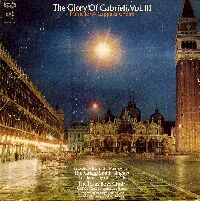
The Glory of Gabrieli (Vol. III)
Liner notes by Gregg Smith
Although Giovanni Gabrieli (1551-1612) is acknowledged as one of the supreme masters of his time, little has been written about the performance practices of his music. We know that Venice reached her greatest glory at the end of the 16th century. We know that the musical style of the Venetian school was generally festive, an antithesis to the so-called sacred style of the Roman school and its great master, Palestrina. This festive approach to church music includes an important emphasis on the use of instruments. As the noted scholar Denis Stevens points out, an important key to the antiphonal music is color, and a great argument can be made for different orchestrations or colorings of the various antiphonal forces. But, at the same time, the use of instruments tends to diminish one very important aspect—the Latin texts themselves. "The Glory of Gabrieli," Volume I (MS 7071), is a glory of sonority. The glory of this volume is the glory of the religious Gabrieli. This is music that belongs in the church service, a part of a more solemn religious experience.
Far more than any great scholar could have done, Venice's St. Mark's Cathedral, where these volumes were recorded, taught us how to perform Gabrieli's music. We were quite sure that the acoustics could not take the heavy vibrato, an unfortunate characteristic of many Italian choirs. And yet, when our forty-three boys and thirty-two adult singers did have to open up their sound in those grand fortissimo passages, the rich reverberation was a wonderful ally.
One
major question plagued us. Not only is this music written for multiple
choirs, but the textures and inner lines are extraordinarily complex.
With the tremendous reverberation of the Cathedral acoustics, how
would these complex textures ever be heard? We learned as performers
that Gabrieli's genius solved this problem. The most important lines
always sounded IF SUNG IN A MUSICAL WAY—sometimes long soaring
lines, arching heavenward, sometimes the most complex rhythmic figures
darting in and out, sometimes both, and then
Our
great guide in performance style became, therefore, our own musical
intuition. The tempos, tone qualities, textures and phrasing were all
arrived at by the simple expedient of what would sound in that
Cathedral, and it is
Most startling of all is the amazing contrast and continual change of musical ideas, especially in rhythm and tempo, ACCORDING TO THE TEXT. In the more severe sacred style of many Renaissance masters, changes of text or verse only called for very subtle changes of musical idea. But with Gabrieli the changes are revolutionary.
Performing some of this music, such as the "Sanctus" and "Benedictus," in a concert hall before going to Venice, made us realize how important it was to bring Gabrieli's music back home to its natural habitat. Although modern recording technology and Gothic cathedrals may seem to be strange bedfellows, this was the proverbial marriage made in heaven. The Church, strangely enough —at least, at St. Mark's—has somewhere dropped its great musical tradition. Many of the priests seemed unaware of, and even unconcerned with, the esteemed names of Gabrieli and Monteverdi. The great musical (and spiritual?) tradition becomes more and more defunct.
If
human events, and even natural ones, such as the slow destruction by
the sea of the city of Venice, continue their present course, this
album may be all that is left to the world in the way of an authentic
re-creation of Renaissance musical life and the spirit that was the
Glory of Gabrieli.
|